Written by: ___
Edited by: ____
As a college student one learns a lot about their peers. It is not always intentional, but you can pick up easily on how others view the world based on prompts they say during class discussions, or even just overhearing conversations while eating in the cafeteria. People always have more to say in an environment without pressure. In this natural environment I have learned many different opinions, but one thing that stood out to me was the way in which fellow students would discuss politics. With the 2020 presidential election quickly approaching everyone has different views, but shockingly not everyone has the same facts or information. For this paper, I wanted to give basic information on important aspects of the election to fuel politically informed conversations. I surveyed to see just how much information the students around me know about the 2020 election.
When discussing politics, it is important to know the universal facts, so let’s start with the basics. Currently in the 2020 presidential election process, we are in the primary stage. There are two different primary election types. First, is a voting primary, in which citizens go into a booth and vote on a written ballot to narrow down all of the possible candidates for the presidential election. Once this process is done there should only be two candidates from each party remaining, then the two final candidates fight for the nomination to be the presidential candidate of their party, which gets decided at the party conventions. The party convention is a gathering of party leaders, where they decide who the final candidate will be for each party. Second, is a caucus. Caucus’ include gathering into a room for voters to be counted rather than voting in a booth, this process also helps to narrow down candidates for the nomination similar to the voting primary. The point of these primaries is for candidates to gain support from voters and delegates to gain the party nominations. Delegates are free agents appointed at the state or local level, their job is to vote for candidates in representation of the populous in the corresponding states. The number of delegates is based on the number of population per state. In the democratic party there are also superdelegates. “Superdelegates are simply ‘unpledged voters.’ Their vote represents their own choice, rather than the wishes of the voters, and these unpledged delegates can pledge their votes as they see fit.” (Chandler “What Are Superdelegates?” 9 March 2020).
Primary elections are held in all 50 states, but this wasn’t always the case. As recently as 1968 only 13 states held public primaries, and the rest of the delegates voted at the party convention. Essentially having people in places of power choose their equals, to stay in places of power. Today, the primary voting system is more inclusive to the public’s opinions. The whole purpose of the primaries now is to gather the public’s decided nominees to distribute pledged delegates accordingly. Voting primaries have been the increasingly more popular way of voting rather than the older version which would be caucusing. Although some states do still caucus, majority have moved to primary voting ballots because it is less time consuming and an easier voting process. With more accurate results from ballots it is a faster system to calculate the winners and to distribute delegates, which is why it is the favored system between caucus’ and primaries.
Caucus. A word we hear about every 4 years, but may not understand and may think we are too old to ask what it is. If you haven’t asked yet it can’t be too important right? Caucus’ are a complex voting system, so I’m going to break down the process. Instead of voters voting in a booth, they gather in a big room and supporters for each candidate get to make their case on why they think their candidate is best. From there, voters gather into groups based on which candidate they support, each group needs a certain percent of the voters participating in the caucus so they try and convince their neighbors to join their group. If a group does not have a high enough percent of voters then the group disbands and voters join other groups, until there are large majority groups. From there the decision of what number of delegates goes to each candidate gets mathematical and more complicated. Essentially, delegates get distributed throughout each voting precinct, and then those delegates get pledged based on what percent of voters in the precinct want a certain candidate. See, I told you it was complicated!
With delegates playing such an important role in the primary process, it is necessary to understand how they work. Each state gets a number of delegates equal to the number of representatives they have in congress. Which breaks down to be one delegate per house of representatives member, and two senators. These delegates “pledge” to vote for a specific candidate during the voting process, based on the popular vote. The break down of this is best explained by the National Archives, “All States, except for Maine and Nebraska have a winner-take-all policy where the State looks only at the overall winner of the state-wide popular vote. Maine and Nebraska, however, appoint individual electors based on the winner of the popular vote for each Congressional district and then 2 electors based on the winner of the overall state-wide popular vote. ” For a candidate to win the party nomination they need to win 270 delegates, which is the majority vote of the total 538.
The general election is in which citizens vote for one presidential candidate from the party of their choice. Each party gets to elect one candidate to be put on the ballot, or citizens can fill in their own candidate in hopes to out vote the parties and win the majority popular vote. On general election day the Electoral College also votes on who they think should be President. The electoral college is a group of representatives, who act in place of their citizens. The electoral college has a total of 538 representatives. Each state has as many votes in the electoral college as they do in congress, one for each member in the house of representatives and two senators. So with the electoral college in place does the popular vote matter? Yes, because the electoral college is there to vote on a governmental level in favor of their citizens. The electors should vote in such a way that shows how the citizens of their state has voted, though it is possible for a candidate to win the popular vote but not the electoral vote, as we saw in the 2016 election.
With all of this general information in my mind, I wanted to find out how much my fellow students knew about the general election. In March of 2020, I conducted an online survey of 18 of my fellow University of Wisconsin-Stout students to find the answer. I asked a series of multiple choice questions and short answer questions to evaluate what sections of the presidential election process they felt comfortable with, and what sequences they wanted to gain more knowledge on. My survey also included opinion based questions on what students were likely to base votes for each candidate on, to find out what issues and beliefs were most important among students when voting.
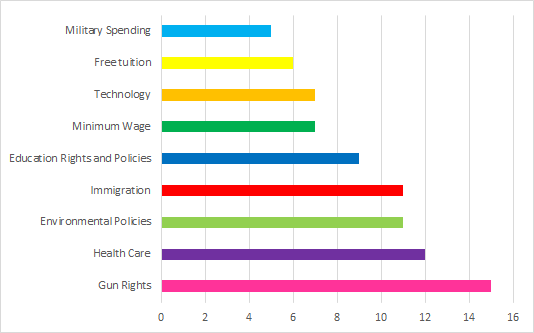
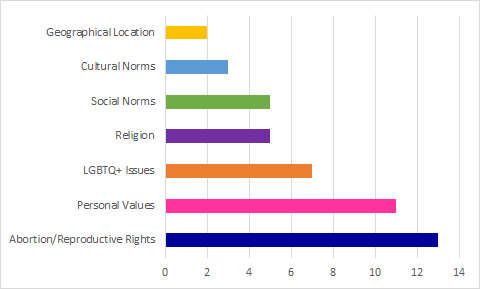
I asked students to choose one or more factors related to issues or policies that impact their decision of which candidate to vote for. The number one factor that students said would impact their voting choices was; gun rights. With health care and environmental policies not far behind (figure 1). I also asked students to pick one or more topics surrounding personal beliefs or opinions that they would prioritize when voting. The issue of abortion and reproductive rights was the topic students felt they would most likely influence their vote (figure 2). The answers to these questions show that students are taking the time to get educated on policies, so that they can successfully make their own choices when voting in the election.
The next question in my survey was; ” Do you think the way you vote impacts the results of the 2020 presidential election?” 16 out of 18 students responded that they either “agree” or “strongly agree” with that question. I asked this because there is the misconception that the way citizens, especially young people, vote has no effect on the election. I was excited to analyze those positive results that show students know just how powerful their vote truly is. Because, even though the final vote is not up to the citizens, popular vote does influence how delegates get distributed. In the modern age, many young voters don’t have faith in our political system and are opting not to vote in elections. When in fact, no matter which party you choose to vote for you are helping parties with delegate distribution, and affecting the way party leaders choose nominees at the convention. It is very important to vote. Voting shows which policies and issues are of public interest in our nation, so people in places of power can make legislation based on the opinions of citizens.
In conclusion, from the primaries, to delegates, to the general election, voting is a complicated process that many may not understand. The whole purpose of the primaries is to get a understanding of the popular vote so the parties can evenly distribute delegates, and give the nomination to one candidate from each party. This leads to voting in the general election for a new President of the United States. I surveyed students to find out how much knowledge they had about the election, and which topics were most interesting to them. With this article my goal was to inform the pubic on the basic systems of the election, and to show the important impact that your vote has on the presidential election.
 RIPE Magazine | Volume 1