By: Cory Hoglund
A lack of competitiveness, little-to-no effort, and absolutely zero defense being played are a few of many reasons on why a drastic change needed to take place. The NBA All-Star Game was first brought about in 1951 with the idea to display the best talent in the league going up against one another. The beginning years of this tradition proved to be a success. However, as the years went by this was no longer true. This can be directly seen in the total points scored in the game in the first 10 (1951-60) and the most recent 10 (2010-19) games played. In the first 10 years the two teams combined for a total of 206.8 points per game (ppg), while in the most recent 10 games played they combined for a whopping 348.2 ppg. This differential in points scored represents the lack of effort and will to win the game, and the NBA needed to put an end to it.
[i] NBA.com. “NBA All-Star Game Recaps: 1950-2020.” NBA.com, NBA.com, 19 Feb. 2020, www.nba.com/history/all-star.
Before we look at the new changes the NBA implemented into the All-Star Game, we must first take a deep look into all of the problems that both the players and us as an audience had with the All-Star Game. A universal problem the players faced was the fact that they really had no incentive to play, and many felt that risking an injury was not worth the reward of winning the exhibition game. With no incentives, comes not trying or caring to win the game, and this led to a poor display of basketball for many years, while really the initial goal of the formation of this NBA All-Star Game was to showcase the best basketball in the world. This lack of desire to win translated directly to the games not being competitive and neither side taking pride in having bragging rights for winning the game for that year. This resulted in almost no defense being played throughout the course of the game, which undoubtedly led to a 48 minutes dunk and 40-foot shot contest. After many years of these recurring problems, the NBA finally made the decision to try to put an end to them by changing the format of the All-Star Game and giving basketball fans a game they will enjoy once again.
New NBA All-Star Game Format:
- Incentive: When a team wins a quarter and/or the game, the NBA will donate a specified amount of money to a community-based organization of the team captain’s choice.
- For the first three quarters of the game, the score will reset at 0-0. The teams are competing to win each quarter because the winner of each quarter will get $100,000 donated to the organization they chose ($300,000 total).
- For the fourth quarter, the points scored from the previous three quarters will be added up for each team, and then 24 points will be added to the team with the highest score through three quarters. Whatever that total is, is the target score. When a team reaches the target score they win the game. The fourth quarter is not timed and has an Elam Ending. The 24 points is in honor of the late Kobe Bryant. Whomever reaches the target score first gets an additional $200,000 donated to the community-based organization that they chose.
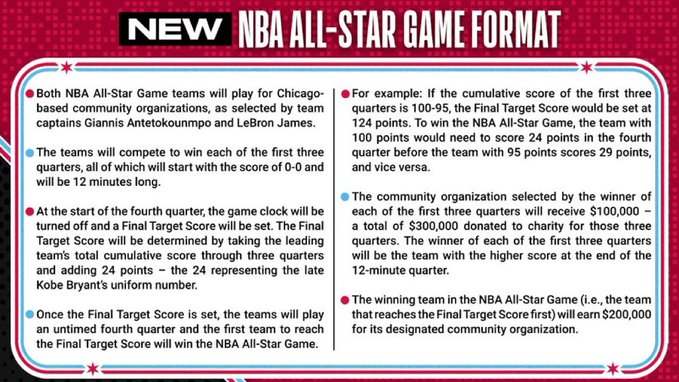
This new format to the NBA All-Star Game was aimed at raising the stakes of the game, as well as increase the intensity of the competition. The donations to community-based organizations was used to try to achieve both of these, while the format in itself, especially the Elam Ending, was designed to bring out the competitive nature in these superstar athletes. Given the circumstances of the death of Kobe Bryant and how he approached his life as an athlete, this also gave an inner desire to each and every player to perform well during the All-Star Game.
Survey
As a way to determine whether or not the new format of the NBA All-Star Game made a difference to the audience’s appeal of the game, I created a short 13 question survey. When conducting the survey, I focused on asked people who I knew either played or enjoy watching basketball. Had I not done this, I would have likely surveyed some people who completely don’t care or don’t know about the topic. It took me from the 24th to the 28th of February to gather all of the data that I needed, and I did this by giving an in-person, paper survey to 20 people. I carried out this survey to look into the opinions of basketball fans on the new format of the NBA All-Star Game, whether or not they thought it originally needed change, and if it still needs change.
Survey Findings
- The new NBA All-Star Game format was preferred by 20 out of 20 people.
- When asked what the number one thing they would change about the new format.
- 11-The game cannot end on a free throw
- 7-No changes
- 2- Add a four-point shot
- The average score between one and five, 1 being not at all and 5 being very, when asked how exciting the old format was and how exciting the new format was.
- Old format = 1.6 out of 5
- New format = 4.6 out of 5
Conclusion
Based on my findings, as well as data from other sources, the NBA took a big leap forward in regard to its All-Star Game. Television ratings for the NBA All-Star Game on TNT showed and 8% increase from the year before with an average of 7.3 million viewers. The Elam Ending fourth quarter is when the ratings reached their highest point with an average of 8 million viewers tuned in. My survey findings revealed that the average basketball fan enjoyed the new format more than the old and is now more likely to watch the All-Star Game in upcoming years than they were in the past. However, these fans are not completely satisfied, and would like to see minor changes to the rules in the future.
[ii] Lafayette, Jon. “NBA All-Star Game Ratings Show 8% Gain.” Broadcasting & Cable, 17 Feb. 2020, http://www.broadcastingcable.com/news/nba-all-star-game-ratings-show-8-gain.
Edited by: Karson Mulvihill
[i] NBA.com. “NBA All-Star Game Recaps: 1950-2020.” NBA.com, NBA.com, 19 Feb. 2020, www.nba.com/history/all-star.
[ii] Lafayette, Jon. “NBA All-Star Game Ratings Show 8% Gain.” Broadcasting & Cable, 17 Feb. 2020, http://www.broadcastingcable.com/news/nba-all-star-game-ratings-show-8-gain.
 RIPE Magazine | Volume 1