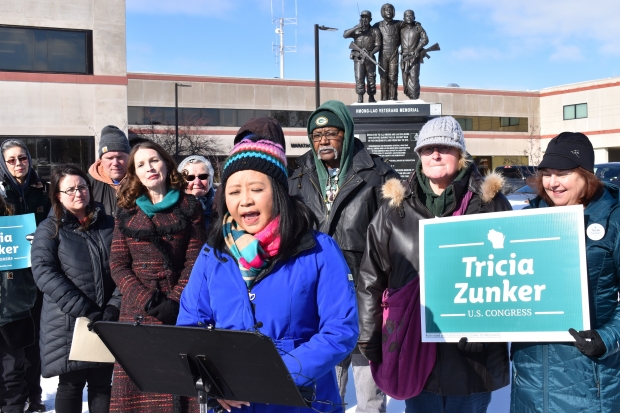
https://www.wpr.org/hmong-leaders-rally-against-trump-administrations-deportation-push
The Hmong and Laotian people came to the United States during the end of the Vietnam War and after the Vietnam War as they were forced to abandon all but the clothes on their backs and some basic human values. Why did we come to the United States of America? Focusing on the Hmong, this is a story that the majority of people from the Hmong second generation know. However, those who came to America as refugees and are permanent residents but have no citizenship and have been criminalized could face deportation.
After the United States publicly announced they would leave Vietnam because of tensions from home and the Communist Soviet Union, they secretly used the CIA to maintain presences the Vietnam. The CIA heard about a group of people who lived on the mountains of Laos and Vietnam. They were the Hmong, under General Vang Pao, a Hmong General who severed in the Laotian army. It was agreed that the U.S could use the Hmong people to fight against the Vietcong, but the only circumstance was that if America does lose, they must take the Hmong with for the reason of being persecuted by the Vietcong. My family came to the United States as refugees. The journey to America isn’t a journey that was comfortable to take. They were always moving and running away from the Vietcong. Their last challenge was to cross the Mekong River. Every Hmong family had their own way of crossing the river. My family crossed the river twice. In the first attempt, my aunt whom I had never met, drowned. In the second attempt, my grandma payed smugglers to take them to the other side in Thailand. From there is where and how they got to America in 1986 in Providence, Rhode Island. As the Hmong lived in the U.S for about 45-50 years, there is a generation of Hmong that has never seen the country their parents came from because they were born here in the U.S. Many of the new generation have assimilated to the American culture, keeping only some Hmong values.
It may seem like the Hmong people are living the American Dream in the U.S. However, just recently, there has been rumors about the Trump Administration having talks with the Laotian government about deporting non-citizen Hmong and Hmong criminals that are residents in the U.S. which would also affect non-citizen Laotians (Mentzer, 2020). This has caused a panic in the Hmong Community. But because the talks of deporting non-citizen Hmong is a rumor, Yee Leng Xiong, the director of Wausau’s Hmong American Center stated, “Because there’s no information [from official sources], it creates this fear. It’s a fear of the unknown,” (Mentzer, 2020). There is about 300,000 Hmong people that lives in the U.S and most are citizens through the process or being born in America. But there are an estimated 4,500 green card holders (legal permanent residents but not citizens) who can be deported because of the crimes they have committed. Those who were criminalized dealt their time in the U.S because the Laotian government wouldn’t accept most U.S deportees (Mentzer,2020). However, it could change if the negotiation is successful between the two governments.
Due to these rumors of negotiation between the U.S and the Laotian government, U.S Representative Betty McCollum of St, Paul Minnesota wrote a letter to Secretary of State Mike Pompeo, showing her support for the Hmong community opposing the plan (Feshir, 2020). I have also conducted two interviews: a Hmong student part of Hmong Student Union from UW-Oshkosh and Brad Karger, Marathon Country Administrator in Wausau, Wisconsin. The student, who shall remain anonymous, explained how after hearing about the negotiations of possible deportations, the organization called for a meeting to talk about it and their concerns. They then formed a statement opposing the idea and voicing their concerns (HSU Member, Personal Communication, March 10 2020). Brad Karger has always shown his support for the Hmong community in Wausau, Wisconsin. He was generous enough to share me his thoughts on the idea of deporting non-citizen Hmong people. He opposed the idea by saying, “I oppose Hmong deportation to Laos for these reasons:
- Many of the 3,500 people subject to deportation have already paid the price for their crime and been rehabilitated. They made a mistake as a young person and have turned their life around. Some have received college degrees, have families of their own and work at a job they have held down for years. Who benefits from their deportation?
- Everyone makes mistakes. No one expects anyone to be perfect. What is expected is that you learn from your mistakes, correct your behavior and move forward in life. Many of the people subject to deportation have done this.
- Hmong people have no connection to Laos. Most of the group subject to deportation have never been to Laos. They likely were in Cambodia at a UN Camp in Laos as a child but certainly not any adult experience in Laos.
- Deportation will break apart families. Everyone has some person in their family who gets into trouble. I know from my own experience that this can be embarrassing but I can’t imagine how much worse it would be if the person were deported and as a practical matter, gone forever. That seems like a penalty that far exceeds the crime.
- Hmong people lived in Laos in the 1960s and 1970s but when was the last time a Hmong person introduced them self as Laotian? Hmong people don’t have a Laotian connection and given the record of the Lao government on human rights, Laos is not a safe place for deportees and their families,” (B.Karger, personal communication, March 13, 2020)
As you can see there are many supporters for the Hmong community and just because I only focused on the Hmong community, I am not disregarding the Laotian people and their concerns. Us Hmong and Laotian people share the same exodus story out of Vietnam and Laos; running from communism because we fought with and for the U.S to stop the Domino effect in South East Asia. But we became refugees, immigrating to the U.S, growing communities, and having a new generation of Hmong and Laotian born into the American culture. The thought of deportation may have never been a reasonable thought until now. Those who are non-citizens and were criminalized could find their way back to a country they are not familiar with and is dangerous for them. Based on these reasons, I will continue to support the Hmong community despite threats of deportation.
Work Cited
Feshir, R. (2020, February 10). What you need to know about Trump’s plan to deport Hmong, Lao immigrants. Retrieved March 10, 2020, from https://www.mprnews.org/story/2020/02/10/what-you-need-to-know-about-trump-plan-to-deport-hmong-lao-immigrants
Mentzer, R. (2020, February 24). Hmong Leaders Rally Against Trump Administration Deportation Push. Retrieved March 10, 2020, from https://www.npr.org/2020/02/24/808071758/hmong-leaders-rally-against-trump-administration-deportation-push
Written By: Chuetou Kha
Edited By: Eli Lee
 RIPE Magazine | Volume 1