
Author: Matthew Hoover
Introduction
Pokémon, short for Pocket Monsters, is a video game franchise that has been around since 1996 when a company called Game Freak made the first games of the series: Pokémon Red and Pokémon Green. The games are about a kid, in a world of creatures known as Pokémon, catching Pokémon, battling other Pokémon with them, and training them, until he/she becomes the champion of the Kanto region. Over the course of the last 24 years, the company has introduced the world to many new familiar faces like Pikachu or Mewtwo, with almost 900 total Pokémon. With new games coming out nearly every year, the franchise has brought joy to people around the globe. Their latest entries, Pokémon Sword and Pokémon Shield, sold over 6 million copies on launch weekend alone, making it their highest-grossing Pokémon game (Watts).
Although Pokémon is a video game meant to entertain people, it is also a competitive esport. Hundreds of thousands of players make teams of Pokémon to battle with, and they challenge other trainers around the world to see who the better Pokémon trainer is. Battling involves a lot of strategy, luck, and skill, but it also involves raising Pokémon to be the best they can be by maximizing their stats in the most efficient way and having them use the best moves to defeat their opponents. In this article, I will be explaining the process of raising a Pokémon for competitive battling in Pokémon Sword and Pokémon Shield. But before I discuss the process, I will need to explain how stats work.
Each Pokémon has six base stats: HP, attack, defense, special attack, special defense, and speed. More information on each individual stat can be found here. Each stat has a maximum and minimum value depending on what level the Pokémon is (from 1-100), its effort values (EVs), its individual values (IVs), and its nature. EVs are values obtained when a Pokémon gains experience in battle by defeating a Pokémon or catching one in the wild. Each stat can have a maximum of 252 EVs, and the total number of EVs a Pokémon can have is 510. EVs will be discussed more later. IVs are set values for each stat (between 0 and 31) that a Pokémon is born with and cannot be changed. Each Pokémon is also born with a nature that cannot be changed. Each nature boosts a single stat by 10% and lowers another one by 10%. A list of natures and which stats they affect can be found here.
Required Materials
Getting the obvious out of the way, you will need a Nintendo Switch with a copy of Pokémon Sword or Pokémon Shield in order to raise your Pokémon. As for the in-game materials you will need, here is a list of the required items or other things you will have to obtain/do in order to follow these steps:
- Complete the main story (defeat Champion Leon)
- Judge feature in your Pokémon Box – defeat Leon in the Battle Tower
- Wishing Pieces – can be bought from almost any merchant in the Wild Area
- Pokéballs of your choice – can be bought in any Pokémon Center or from some merchants in the Wild Area
- Everstone – hidden item southeast of Turffield Stadium
- Destiny Knot – can be bought at the BP Shop in the Hammerlocke Pokémon Center for 10BP
- Macho Brace/Power items – can be bought at the same BP Shop as the Destiny Knot for 10BP each
- Technical Machines/Records of your choice
- Held Item of your choice
Steps
I will follow along these steps myself and show examples of what I am doing along the way.
Step 1. Determine which Pokémon you want to use in battle.
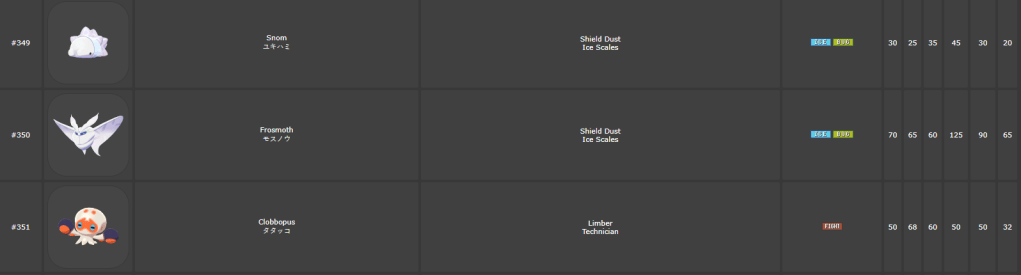
A full list of Pokémon that can be obtained in the Galar region can be found here.
Step 2. Determine how you want to build that Pokémon.
You will have to decide what nature it should have, its IVs, and what ability it should have. From the link in step 1, you can see the abilities and base stats of each Pokémon, and you can click on whichever Pokémon or ability you want to find more information about it.
Before deciding any of that, however, you will need to decide whether the Pokémon should be a physical or special attacker. Normally a Pokémon will utilize whichever attack stat is higher. Even so, you will want to look at which moves it can learn and determine if it would be better as a physical attacker or a special attacker.
Usually the nature of a Pokémon should increase one of its best stats and decrease either its attack or special attack. Some common natures are adamant, jolly, modest, and timid. The IVs will almost always need to be 31 in each stat, unless you are not using that stat at all (e.g. Pokémon utilizing its attack stat instead of special attack will not need 31 in its special attack stat). Another time you would want to have a lower stat is if you are utilizing the move Trick Room, which makes it so that the slower Pokémon in battle moves first for 5 turns. In that case, you would want to have 0 for the speed IV so that your Pokémon is more likely to be slower. The ability of a Pokémon is more of what your preference is. You will have to look at its options for abilities and decide which one would be best for your battle style.

Step 3. Determine which moves the Pokémon will learn.
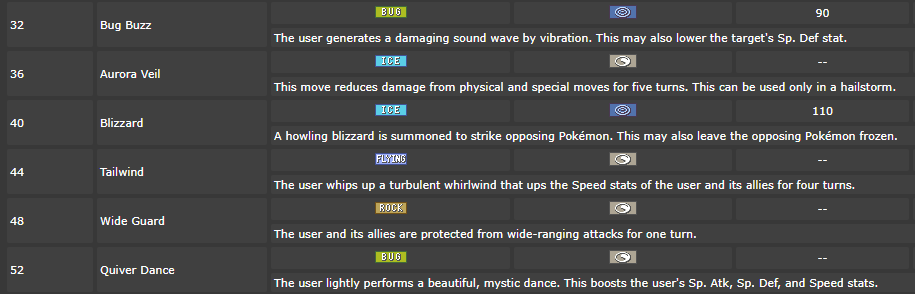
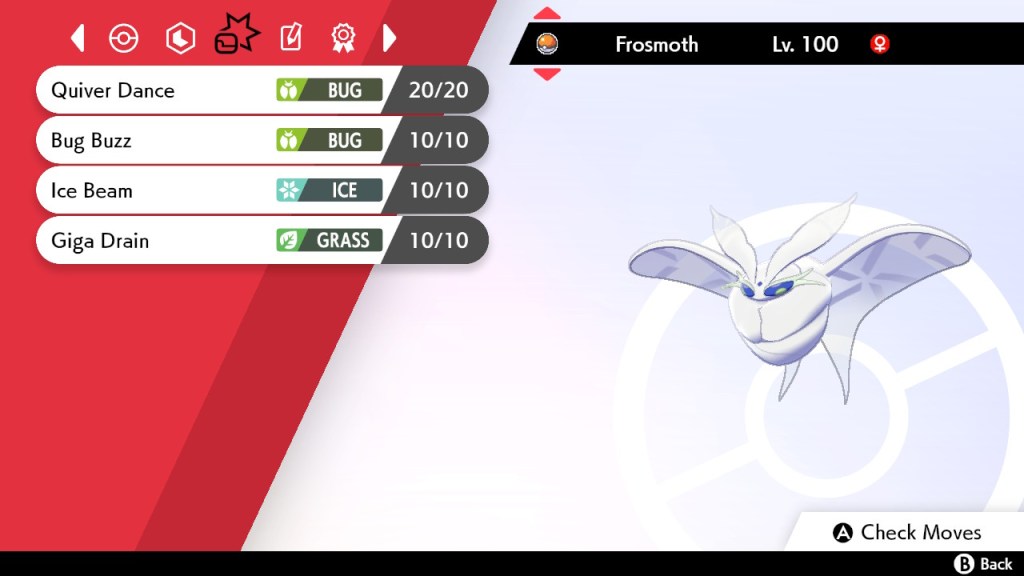
It is important to remember that a single Pokémon can only know up to four moves at a time. Clicking on the name of the Pokémon from the list linked in step 1 will give a lot more detailed information about the Pokémon, including which moves it can learn. Most of the time, the more useful moves are learned by the Pokémon leveling up or teaching it via Technical Machine (TM) or Technical Record (TR). If a move that it can learn is classified as an egg move, that means it can only be learned by its parent breeding with a different Pokémon that already knows that move. Step 5 will talk more about breeding.
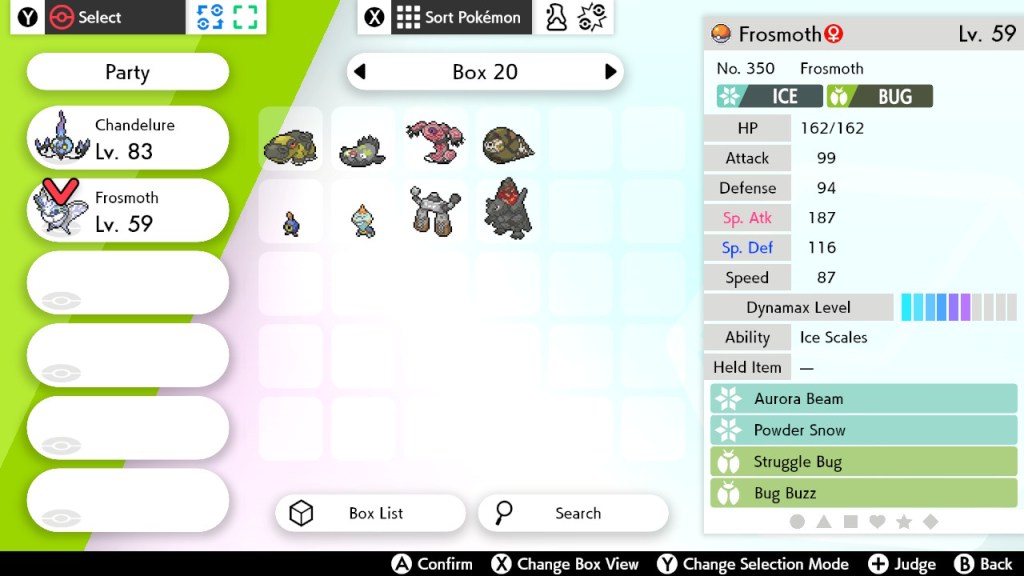
Step 4. Catch a parent Pokémon to breed for your competitive Pokémon.
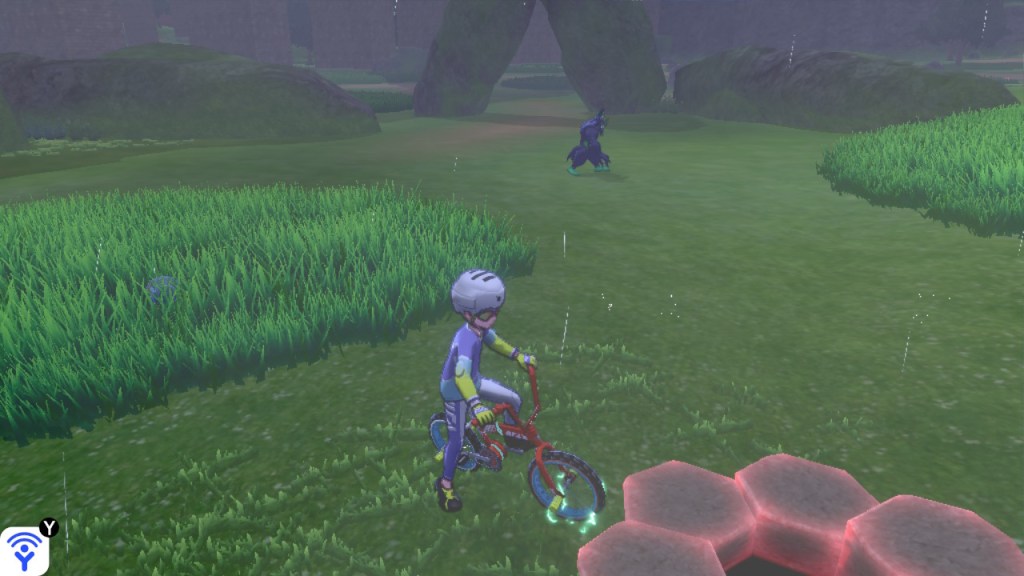
Please note that if a Pokémon has an evolution line (e.g. Charmander to Charmeleon to Charizard), any Pokémon in the evolution line can be used as the parent Pokémon. This rule does not apply to baby Pokémon, which cannot breed (e.g. Riolu, Cleffa, Munchlax). Also note that if you need to give the competitive Pokémon an egg move, you will need the parent to be female. This will be explained in step 5. It is easiest to catch a Pokémon from a high-leveled max raid battle. The Pokémon obtained from 5-star max raid battles will always have a few guaranteed IVs that are 31, so this will make it easier to give the children the best stats they will need. A list of all Pokémon available in max raid battles and the dens to find them in can be found here. You will have to click on the den numbers to find out which locations the dens can be found. If the ability you want on the Pokémon is its hidden ability, you will have to make sure you choose a den in which the Pokémon you are looking for is able to have its hidden ability there.
Once you know which den you will be looking in, you can search for the specific Pokémon you want by using the trick shown in this video from the linked time to 4:22. Once you find the Pokémon, battle it, catch it, and check if it has the ability you were looking for. If it does not have the right ability, repeat this step until you have the right one.

Step 5. Catch the other parent Pokémon.
If you need to pass down the egg move to the child, then the other parent will need to be a male of a different species of Pokémon that is in the same egg group as your first parent that can also learn the move you want your competitive Pokémon to learn. Every Pokémon has at least one egg group it is in. Pokémon in the same egg group as each other can breed together and produce a child. The child Pokémon will always be the same species as the female parent. For example, since Rhyhorn learns Dragon Rush as an egg move, if a male Charmander that knows Dragon Rush were to breed with a female Rhyhorn, then the child would be a Rhyhorn that knows Dragon Rush. A list of which egg groups Pokémon are in can be found here.
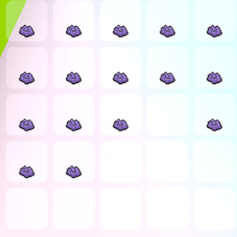
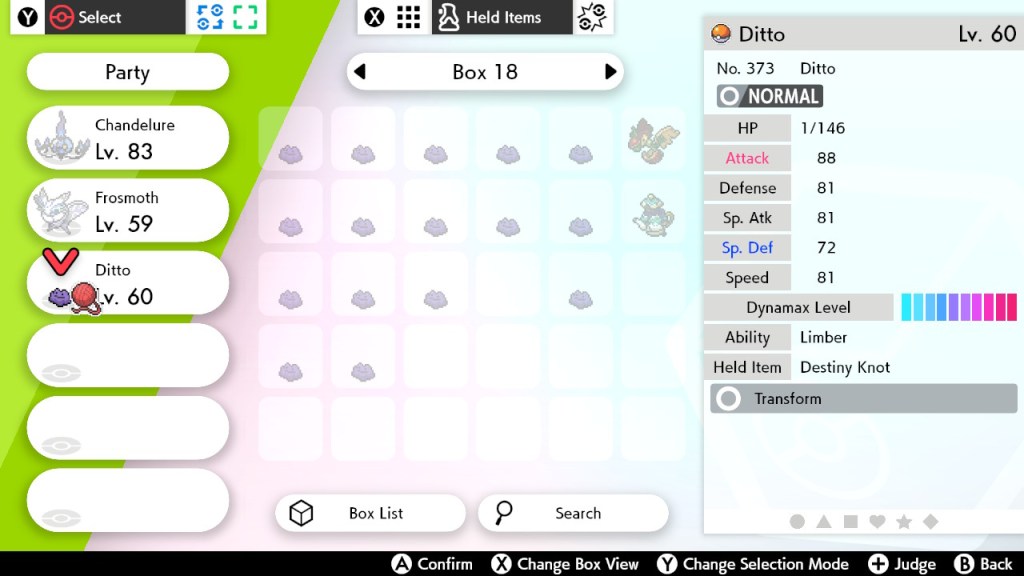
Next, you can either catch the opposite gender of the same Pokémon you caught in step 4, or you could catch a Ditto, which can breed with any Pokémon not in the undiscovered egg group. It is recommended to catch at least a few Ditto if you are going to breed Pokémon more than once. Having a few Ditto with different perfect IVs can make it easier to pass down the right stats when breeding. Either way, you might need a few different parent Pokémon anyways in case the children do not have the correct IVs. This will be discussed more in the next step.
Step 6. Time to breed your Pokémon!
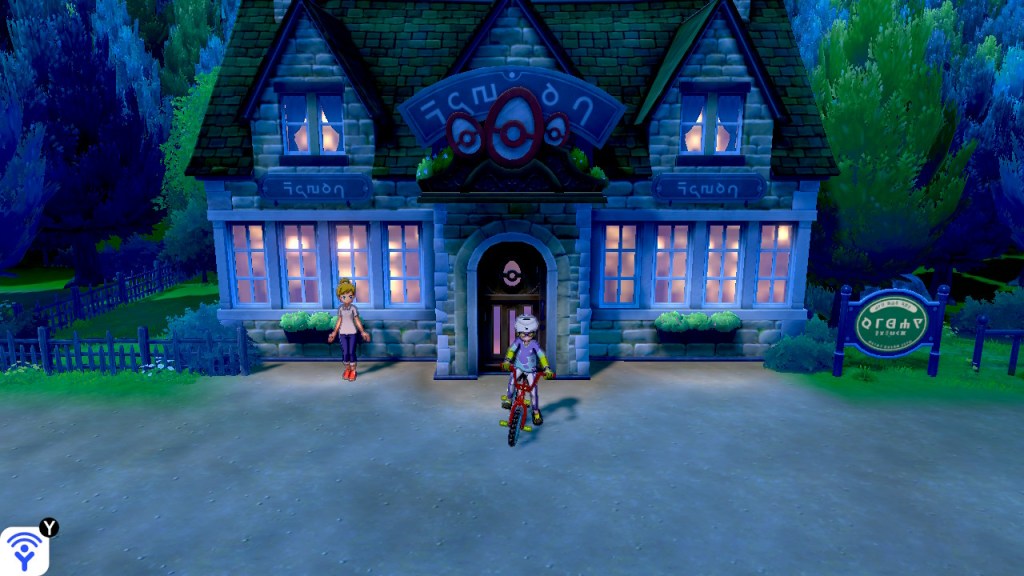
There is a nursery on Route 5, and there is another nursery in the Bridge Field in the middle of the Wild Area. Talk to the Day Care Lady outside, and she will ask if you want to leave your Pokémon there. You can only leave two Pokémon in one nursery at a time, so leave the two parents you got ready for this step.
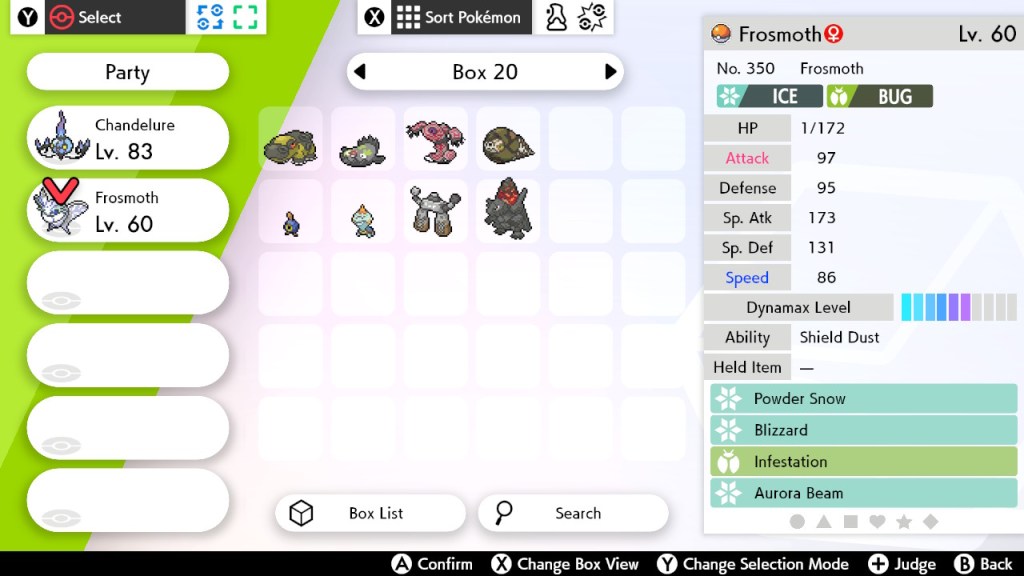
If one of the parents already has the desired nature, then have that parent hold an everstone. Holding an everstone will pass down the nature to the children. You can tell what nature a Pokémon is by looking at its summary. You can see which stats the nature enhances and diminishes by scrolling left or right to its stats. The enhanced stat will have pink text, and the diminished stat will have blue text. Have one parent hold a destiny knot. This will guarantee that the parents pass down five of their stats randomly to the child, with the sixth being entirely random.
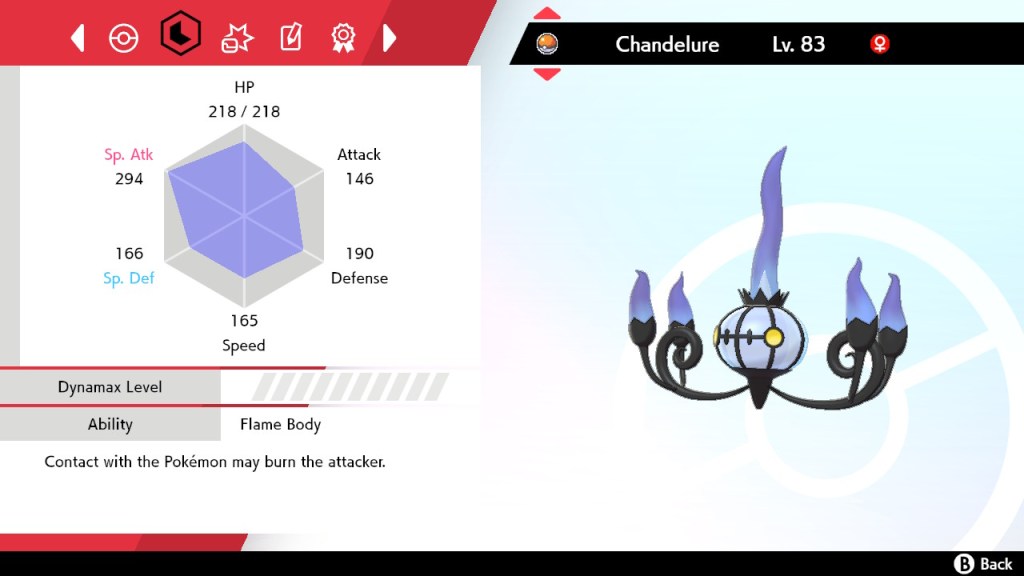
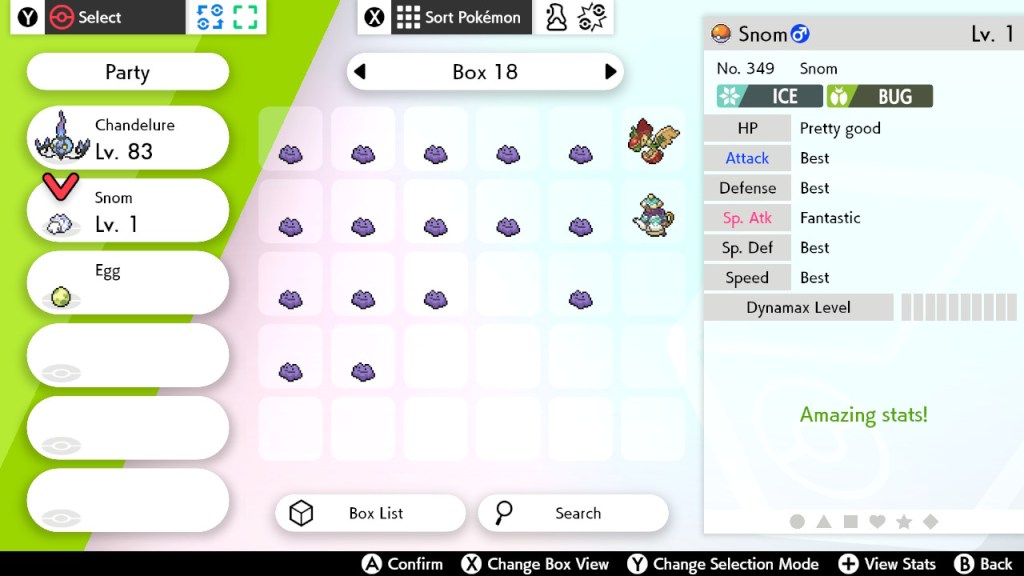
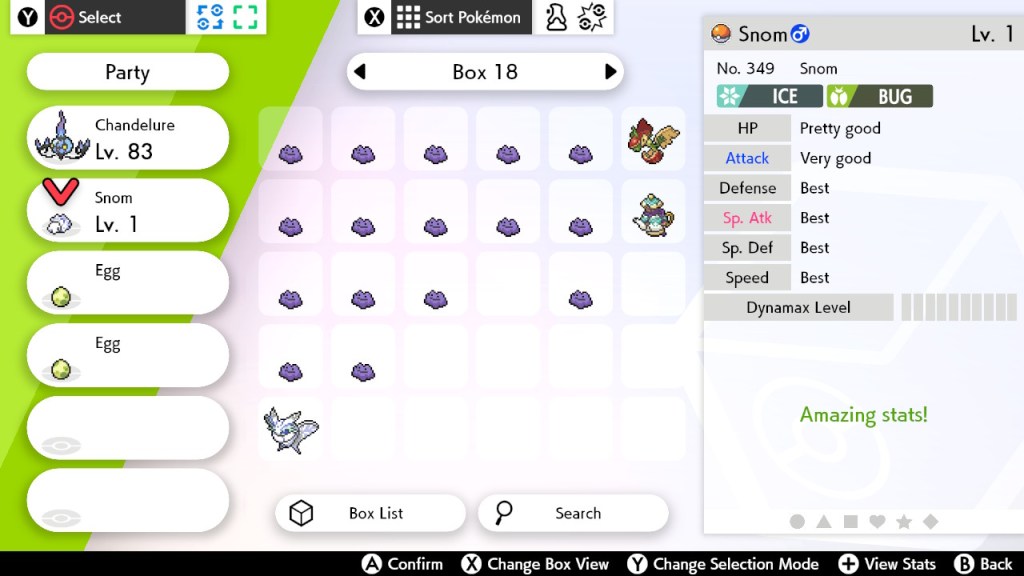
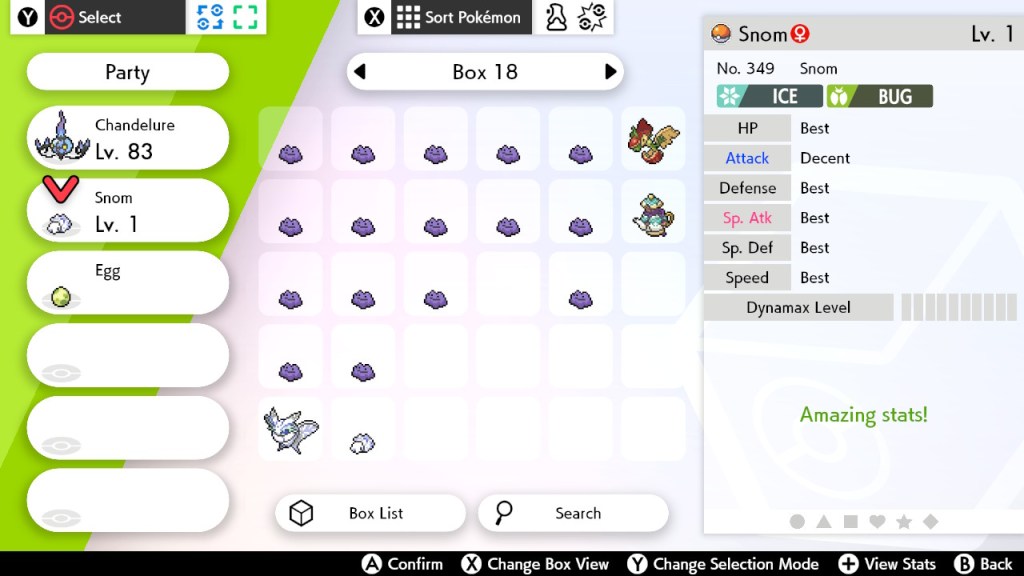
For the Pokémon to breed, they will have to be kept in the nursery for a certain number of steps that you take in game. Depending on how compatible they are (which can be checked by talking to the Day Care Lady), they have a chance of producing an egg every 256 steps. A link to a page with the chances of producing an egg can be found here. After receiving the egg, you will have to take a certain number of steps to hatch it. This process can be sped up by having a Pokémon in your party with the ability Flame Body. This doubles the rate of hatching eggs in your party. The child Pokémon will hatch at level 1, and you can check if it has the correct egg moves, nature, ability, and IVs by looking at it in your Pokémon Box.
After passing down an egg move to a child, you may switch to using that child as one of the new parents so you do not need to use a different species of Pokémon anymore. As long as one of the parents know the desired egg move, it will always be passed down to the child. Breed the new parents together until you have the correct nature on one of the children and use that child as a new parent. Repeat this process, passing down IVs to the children and switching out the children with better stats for the parents, until you have the perfect IVs you are looking for. It is important to remember that the parents must have the correct ability that you want to be passed down. If it is a hidden ability, it can only be given to the child by being passed down from the child. If it is a normal ability, then the chances are much higher of passing down that ability than being a different one.
Once you have the correct moves, ability, nature, and IVs on a child, you can move onto EV training and leveling up your competitive Pokémon.

Step 7. EV train your Pokémon.
To recap, a Pokémon can have up to 252 effort values, or EVs, in one stat and up to 510 total. It is usually best to max out two of its best stats and put the rest in another. Every Pokémon has an EV yield, or an amount of EVs given to the Pokémon that gain experience from catching or defeating that Pokémon. A list of each Pokémon’s EV yield can be found here.
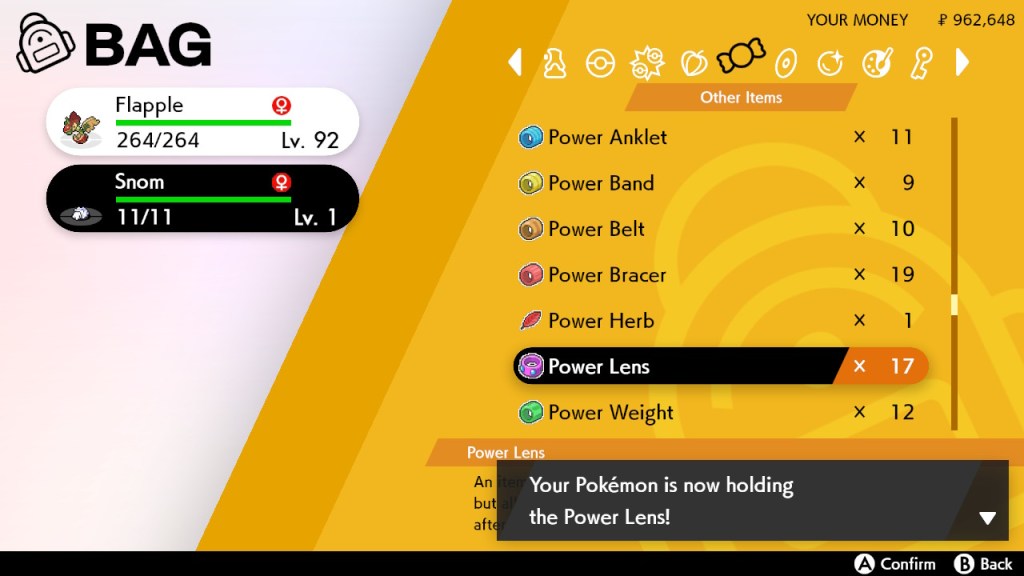
Once you have determined what your Pokémon’s EV spread will look like, you can then start battling wild Pokémon to EV train your Pokémon. Before EV training, remember to put EV training items on your Pokémon so that it will gain EVs faster. The Macho Brace will allow the Pokémon to gain EVs two times faster. The Power Anklet, Power Band, Power Belt, Power Bracer, Power Lens, and Power Weight will give eight EVs in whichever stat the item specifies for each Pokémon caught or defeated, no matter what EV yield the Pokémon has.
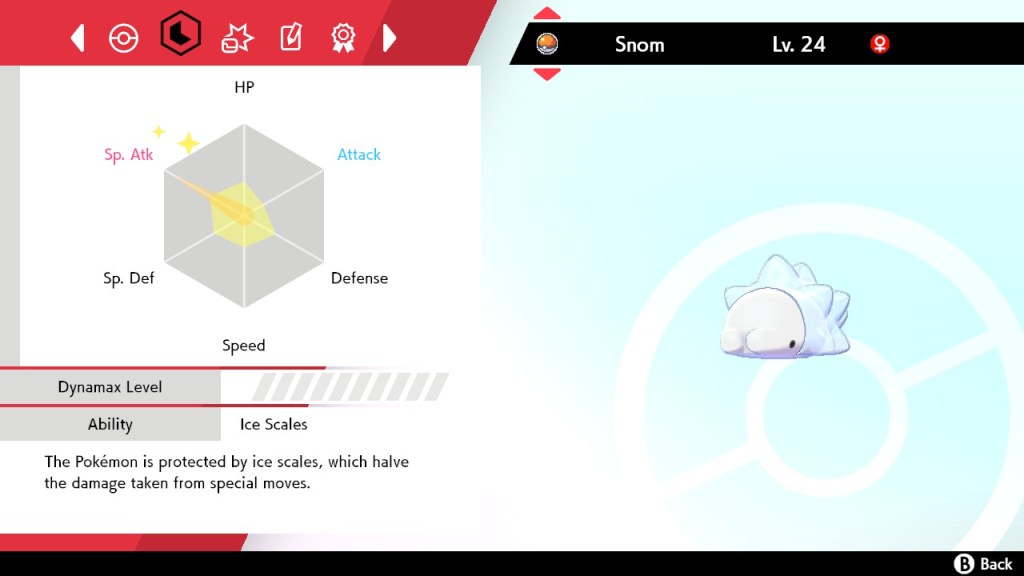
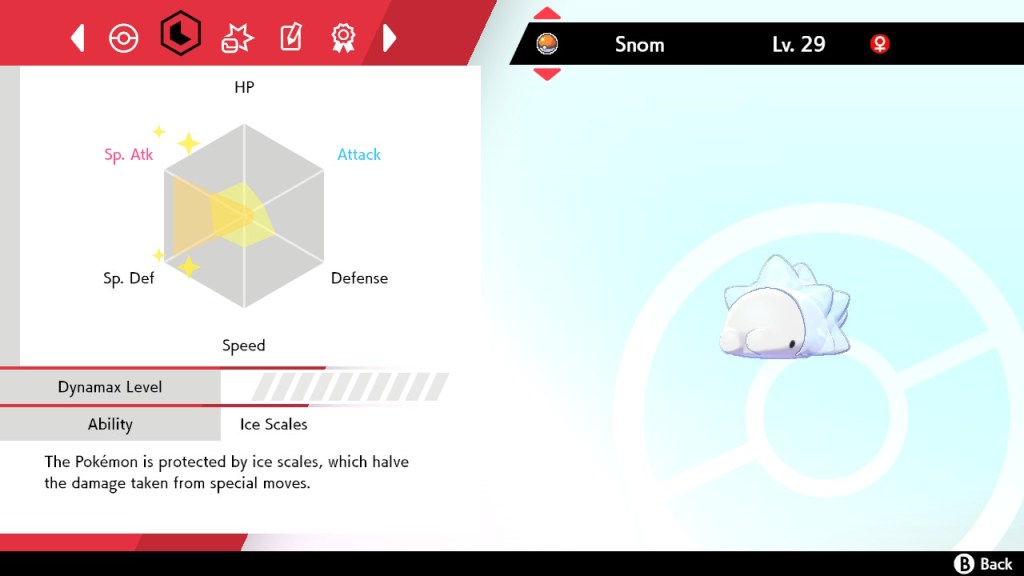
You can check your EV progress by checking your Pokémon’s summary, moving left or right until you get to the page that shows its stats in a hexagon shape, and pressing the X button. There will be an orange shape in the middle of the hexagon that indicates your progress in each stat. The closer a corner gets to a stat, the closer it is to being maxed out. You will know a stat is maximized when there are sparkles over the name of the stat.

Step 8. Evolve, level up, and teach it moves.
If your Pokémon does not evolve, then just level it up to whichever level you need it to. If it does evolve, then determine if any of its moves are exclusively learned by a prior evolution. If it has any of those, then teach it those moves first before evolving. If not, then evolve it and level it up to your desired level. You can see how a Pokémon evolves by looking at the same page as in steps 2 and 3. Many Pokémon evolve at a certain level, so they will likely evolve along the way when leveling up. Most of the time, you will just want it to get to level 50 since that is the level of competitive battling, although some Pokémon evolve after level 50 or learn moves at a higher level. Most moves are learned before level 50, or they are learned by TM or TR.
Step 9. Give it a held item.
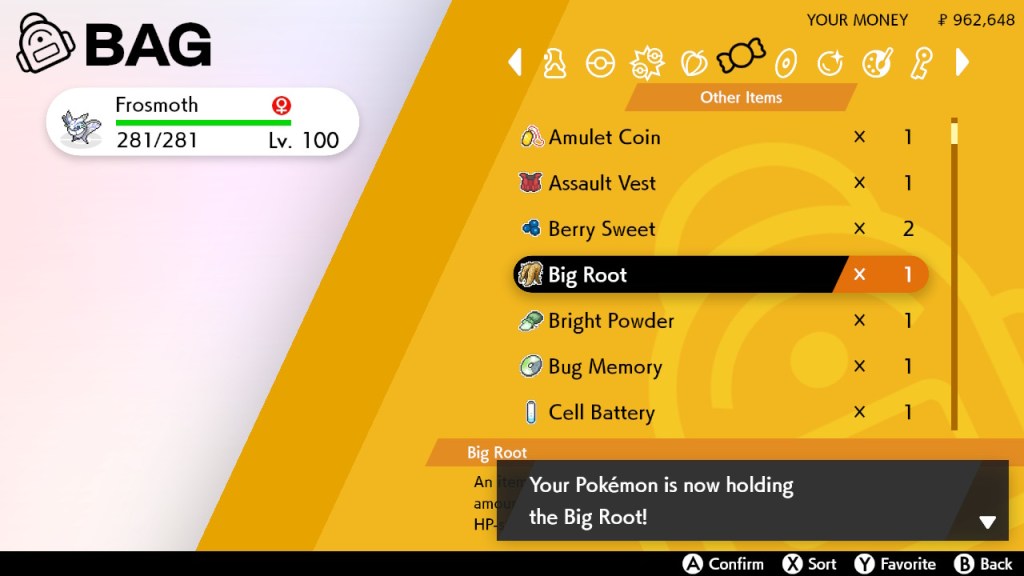
Much like the moves and ability you give your Pokémon, the item it holds is solely dependent on what you want to give it. While I do not have recommendations for every single Pokémon, I can recommend that if you do not know what to put on it, berries are always useful, even if they can only be used once in a battle.
Result
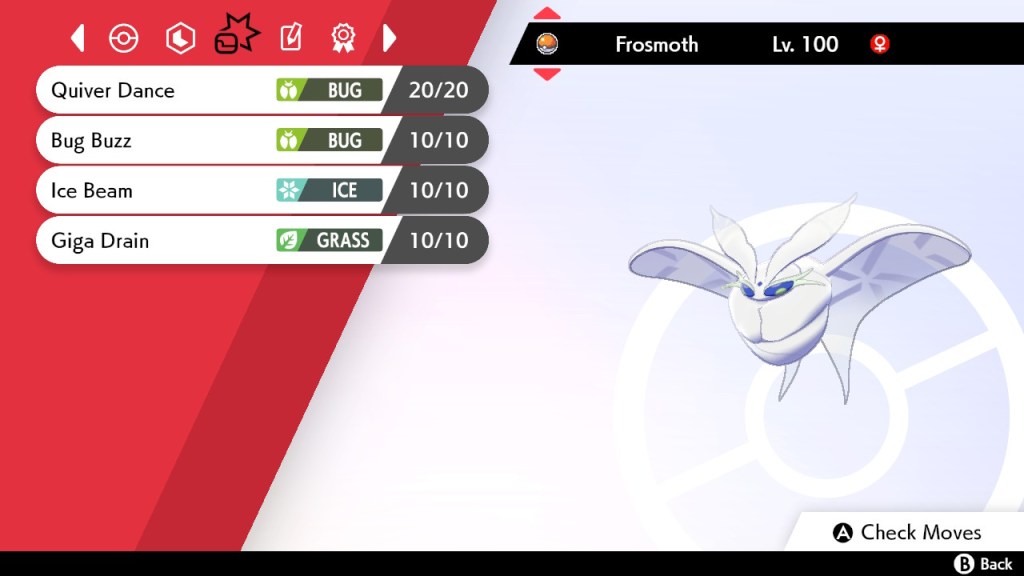
My Frosmoth is leveled up, trained with the correct effort values to maximize its best attributes, has a beneficial nature for its base stats, and has the moves I wanted it to learn so it can be a fierce opponent in battle. Now that Frosmoth is ready for battle, I can train up a few more Pokémon as well to make my team an unstoppable force.
References
Watts, Steve. “Pokemon Sword And Shield Had A Record-Breaking Opening Weekend.” GameSpot, Gamespot, 21 Nov. 2019, http://www.gamespot.com/articles/pokemon-sword-and-shield-had-a-record-breaking-ope/1100-6471623/.



























 RIPE Magazine | Volume 1